


Ornament Info – Fine wooden style ornaments, hand-carved.
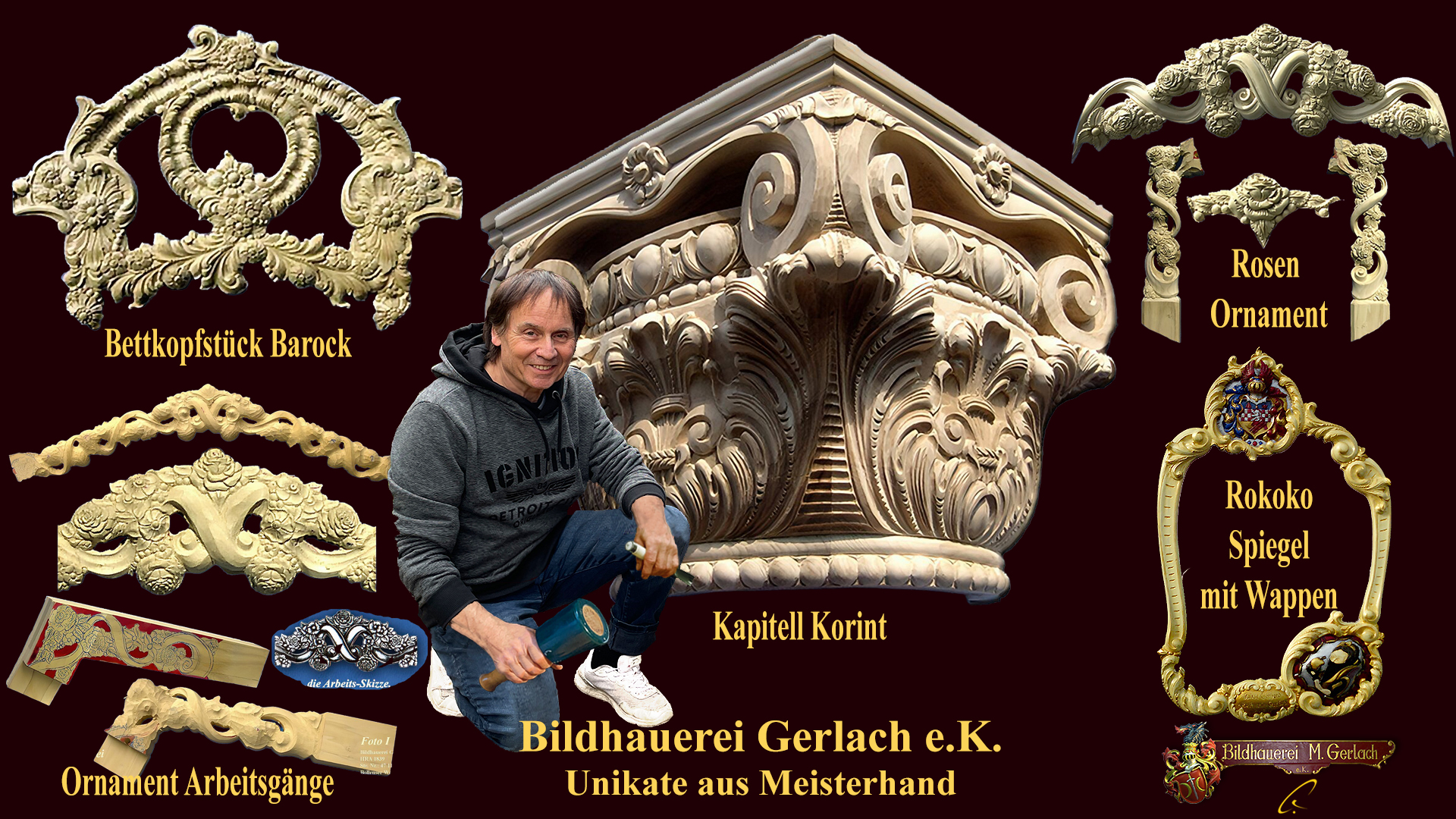
Here you will find answers to the most important questions about hand-carved wooden style ornaments for furniture, doors, facades, frames and interior work.
At Bildhauerei Gerlach e.K., every ornament is a one-off — carved by hand in pure craftsmanship. Each piece is unique.
What types of carved ornaments are available?
In my workshop, I create for example:
- Historical style ornaments based on original models
(Romanesque, Gothic, Renaissance, Baroque, Rococo, Classicism) - Leaf and plant ornaments
(Acanthus, palmettes, vine leaves, oak, laurel) - Furniture ornaments for period furniture
(crowning elements, panel frames, profiles, decorative moldings) - Frame ornaments for mirrors, picture frames and home altars
- Facade ornaments
(gable decoration, door crowns, house inscriptions) - Ornaments for doors and front doors
(panels, capitals, friezes, cornices) - Custom one-offs based on your design
classic or freely interpreted
Every ornament is carved by hand — no CNC, no mass production. This keeps the forms lively, soft and natural, just as historical models intended.
Historical style ornaments – overview of the main periods
To help you understand how different ornaments can be, here are the most important styles of European furniture and architectural art:
Romanesque (approx. 850–1250)
Features: round arches, strong block forms, palmettes, interlace
Look: massive, grounded, simple archaic shapes
Typical: round arches, broad profiles, early leaf ornaments
Gothic (approx. 1230–1500)
Features: pointed arch, tracery, vines
Look: soaring, delicate, pierced structures
Typical: tracery windows, long leaf tips, finials
Renaissance (approx. 1500–1620)
Features: classical temple structure, coffers, volutes
Look: clear, harmonious, architecturally ordered
Typical: egg-and-dart, bead molding, acanthus, dentil
Baroque (approx. 1600–1730)
Features: heavy forms, strong profiling, movement
Look: dramatic, rich, monumental
Typical: powerful acanthus leaves, S-curves, dynamic folds
Rococo (approx. 1730–1780)
Features: light, asymmetrical rocaille shapes
Look: playful, flowing, lively
Typical: shell forms, C- and S-curves, delicate leaf volutes
Classicism (approx. 1770–1830)
Features: clear structure, calm forms
Look: strict, elegant, antique-inspired
Typical: laurel wreaths, garlands, coffered fields
How is a carved ornament made?
A hand-carved ornament is more than decoration — it is a small artwork. Only careful planning, accurate drawing and precise craftsmanship bring out its form. In my workshop, each ornament is made in several steps:
1. Design & drawing
Every ornament begins with a sketch — either based on historical styles
(Baroque, Rococo, Classicism etc.) or entirely according to your ideas.
Proportions and style characteristics must be exactly right.
2. Choice of wood
For fine, elegant ornaments I usually use lindenwood.
For doors and facades: oak. For furniture: maple, walnut or mahogany.
The wood influences both appearance and durability.
3. Rough carving
With sharp carving tools the basic forms are developed.
Now you can already see the movement of the ornament:
volutes, leaf edges, rocaille curves.
4. Fine carving & detailing
The most important step: leaf veins, light edges, roundings, delicate recesses —
everything is carefully carved by hand. This is where the experience of the master carver shows.
5. Surface treatment
Depending on your wish: natural, stained, oiled, painted or gilded —
optionally patinated for a true antique finish.
6. Final check & fitting
Finally the ornament is fitted to its intended position and visually adjusted.
Proportions, depth and light effect must be right before the piece leaves the workshop.
Pricing: What does a hand-carved ornament cost?
The price of a carved ornament always depends on the amount of work. Important factors include:
- Size and thickness of the wood
- Style period (e.g. Romanesque simpler → Rococo very detailed)
- Depth and complexity of the carving
- Wood type (linden → more affordable, oak/walnut → higher)
- Surface finish (natural, painted, gilded)
As a rough guideline:
- small simple ornaments often start (net) at €80–€160
- medium-sized ornaments (Baroque/Rococo) are often €190–€600 (net)
- larger pieces or fully carved style ornaments can cost €600–€1,500 or more
- custom one-offs to an exact customer design are calculated individually
For each ornament I prepare a non-binding quotation as soon as I know size, wood type, motif, style period and the intended use (furniture, door, frame, facade). A photo or a small sketch is often enough.
Master woodcarver Manfred Gerlach
- Home
- Coats of arms – overview
- Coat of arms information
- Heraldry glossary
- Family Coats of Arms
- Coat of arms videos
- Coat of arms flip shows
- Ornaments
- Ornament Info
- Ornament Lexicon
- Figures & documentation
- Sacred works
- Front doors
- Half-timbered work
- Period furniture
- my eBay shop
- Privacy policy
- Imprint / legal notice