
 ..... « back
..... next »
..... « back
..... next » 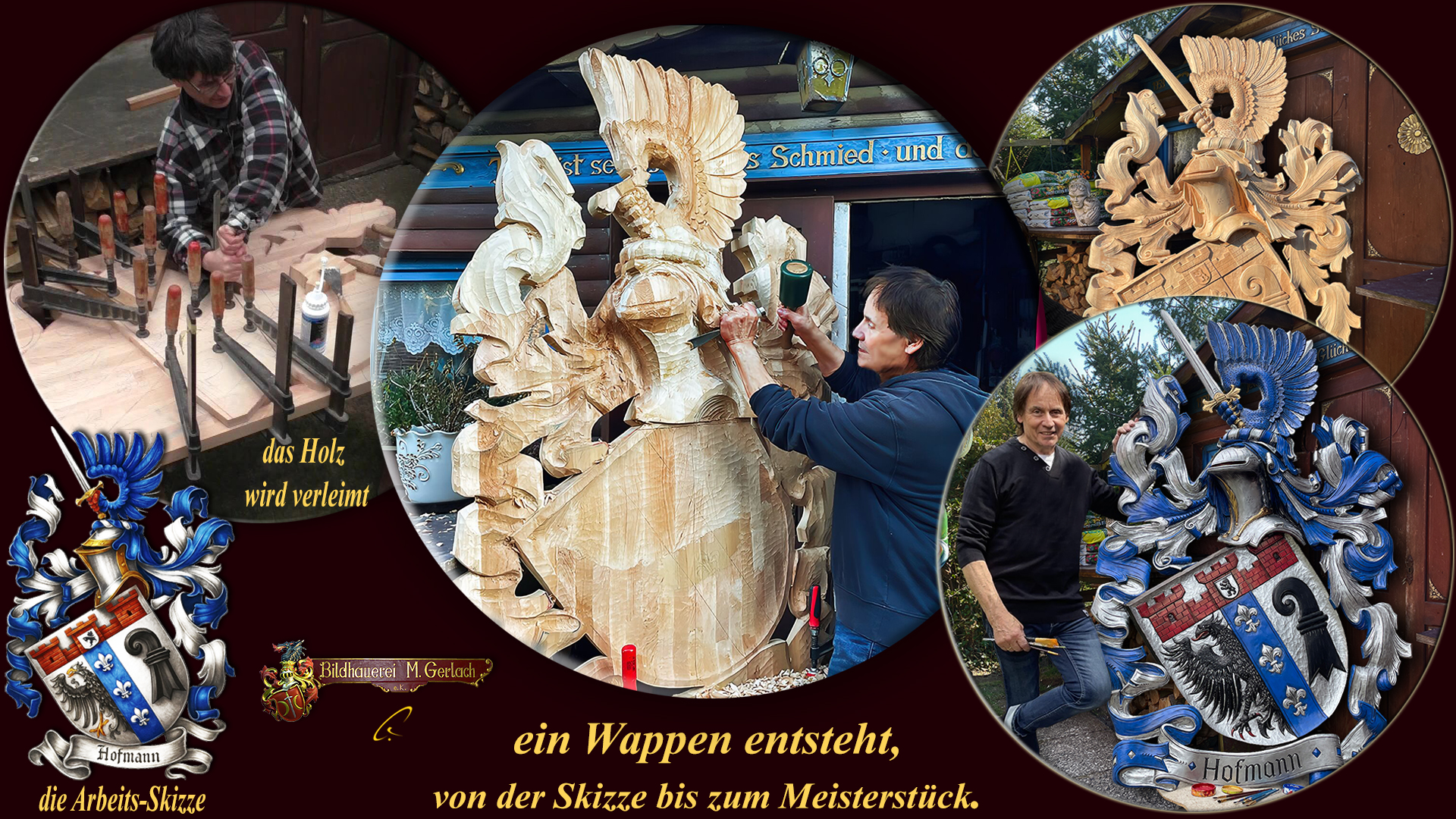
Presse:
"
Heraldic coats of arms – yesterday and today
Heraldic coats of arms have been visible signs of origin, rank and identity for many centuries. In earlier times they helped to recognise knights and nobles in full armour on the battlefield. Today more and more families are interested in their roots and wish to use their own family coat of arms or civic coat of arms.
This interest in heraldry creates work for genealogists, heraldists, artists and craftsmen. In my workshop in Wrestedt I carve heraldic coats of arms in wood by hand – from the first sketch to the fully painted and, if desired, gilded coat of arms.
The large photo above shows the main stages – from the 1:1 drawing to the finished, carved and
coloured noble or alliance coat of arms. A detailed picture documentation can
be found here:
Bookflip – Emme coat of arms.
An overview of my previous work – family coats of arms, noble coats of arms,
fraternity and city coats of arms – can be found on my coats-of-arms overview
page:
Coats of arms overview – Bildhauerei Gerlach.
In practice there are three typical ways to a coat of arms:
On request I cooperate with experienced heraldists. A new coat of arms can then be registered in an official coat of arms roll, for example at the Münchner Wappen-Herold. Such a registration is subject to a fee but offers additional security against misuse.
Over time a number of different types of coats of arms have developed. In my workshop I carve, among others:
A selection of finished works can be seen here:
Wall of Fame – picture show and City coats of arms – documentation .
Everything starts with the design – either an existing coat-of-arms document (for example from a coat of arms roll) or a new draft based on the customer’s wishes. From this I create a 1:1 working drawing, which is later transferred to the wooden panel.
In this phase I already determine:
For larger coats of arms (for example around 65 cm high) I use a base panel of approx. 4.5 cm thickness. This panel consists of several tooth-jointed wooden bars which are glued together.
The bars receive a special toothed profile and are glued in a zigzag pattern. This greatly reduces natural tensions in the wood:
After the panel has been prepared, I transfer the full-scale drawing to the wood and saw out the outline of the coat of arms. Thicker areas (helmet, shield, crest) are built up with additional glued pieces in order to gain more relief height.
These steps can be seen in a small slide show:
Slide show – Heidelberg coat of arms
Now the real woodcarving begins: the coat of arms is carved completely by hand, without CNC machines.
First I work out the rough shapes: heights and depths, the position of helmet, crest, mantling and shield are carved in three dimensions. At this stage the overall harmony and perspective of the coat of arms are defined.
At the same time I also work on the back of the piece. To make a thick coat of arms appear visually lighter on the wall, I remove material on the back in those areas that form the highest points on the front.
In the fine-carving phase all details are added: edges, folds, veins of leaves, feather and fur structures, ornaments and lettering. Here every cut decides on the final expression of the work – experience and a steady hand are essential.
After carving, the surface is carefully smoothed and prepared for painting. The colouring follows the rules of heraldry: metals (gold, silver), colours (gules/red, azure/blue, sable/black, vert/green, purpure) and any furs.
Step by step I build up colour layers, shadows and highlights until the coat of arms appears fully three-dimensional. On request I finish selected parts with gold leaf or silver leaf and, if desired, a light patina to give the piece a historic character.
The finished coat of arms leaves my workshop ready for mounting and is securely packed for transport by parcel service or carrier. The result is a unique piece that can accompany a family, institution or fraternity for generations.
If you are thinking about having a family coat of arms carved in wood or if you would like to realise an existing design as a wooden relief, simply send me an e-mail – ideally with a drawing, photo or short description.
General information on types of coats of arms, prices and working process can also be
found on
Coat of arms information and in the
Heraldry glossary.
Master woodcarver Manfred Gerlach